The 5 technologies with which we will remember 2014

Since the mid-1990s, there has been a constant that states that there is no longer room for constants. Agriculture is no exception to this trend. Every year we witness how technologies considered innovative are being replaced by newer and more modern solutions for modern agriculture.At the end of 2014, when it is time to take stock, we selected the 5 most significant technologies that have changed the way farmers manage their farms.#1 Satellite Imaging of Agricultural AreasImagine a technology with which you can monitor your fields from space and monitor indicators such as plant vitality and development over time. This is not a worldwide novelty for 2015, but now this technology has expanded its popularity and is also known among farmers outside the United States, including farmers in Bulgaria.Satellite technology allows to see in the fields things invisible to the naked eye, which are a consequence of infrared rays and the way plants absorb them and reflect in their inner layer under the name “parenchyma”. It is no coincidence that the motto of GeoScan* is “See the invisible!”. *GeoScan is the first crop monitoring program in Eastern Europe, which is based on the Bulgarian software TechnoFarm.#2 Variable processing rateAlso known under the initials VRA (Variable Rate Application), the variable rate in agricultural operations is being implemented more and more successfully in Bulgarian farms. With the improvement of the maps with prescriptions, whose objective is the precise and optimized processing of the plots, the VRA has established itself as the leading technology for carrying out agricultural operations. This trend is also confirmed by the American leaders in precision agriculture Trimble, whose innovative solutions are increasingly betting on the variable rate as a way to optimize costs, on the one hand, and on the other - to treat the land in the most optimal way.Speaking of prescription cards, we cannot fail to note their important role in soil nutrition and plants, which is one of the most important initial conditions for a good yield. Based on the results of the analysis of soil and plant samples from a field, variable rate treatment prescriptions can be drawn up, the purpose of which is to ensure optimal crop nutrition and disease management where necessary, without entailing additional costs for fertilizers or preparations. On the contrary, costs are almost always lower. Looking to the future, VRA technology will continue to be a hot topic in the coming years, when we will continue to monitor its development and improvement.#3 Informed SolutionsAlthough we place them in 3rd place, informed decisions are at the heart of precision agriculture — without them it could practically not exist. 2014 was marked by the laying of the foundations and the first steps towards the accumulation of a huge database that could be a reliable source of up-to-date information leading to informed and precise decisions. Over the past 12 months, millions have been invested in the collection and storage of data from fields around the world — something investors expect to rival Facebook and Google in importance. Undoubtedly, collecting, processing and sharing data to make informed decisions is both an opportunity and a challenge, especially for farmers. “On the one hand, we are excited about all the positive changes that a huge database can bring to be our “right hand” in planning all events on the field. On the other hand, however, we must think carefully about the storage of the information itself. “, comment from the industry.#4 “Smart Devices”In 2013, the so-called smart devices were in the leading position in the first position in the technology review of the year, and their 4th place in just one year is proof of how much they have become an integral part of our daily lives.Do we fully realize what necessity these devices have become? At the heart of the technological revolution are smartphones, which have completely transformed the way we communicate, but have left their mark on all other areas of our lives. Farming is no exception.Farming has managed to be implemented in mobile phones, as well as they in it, thanks to mobile applications with which the farm is a click away from anywhere in the world. The truth is that the driving force behind “smart devices” is in mobile applications, through which the collection, analysis, storage and exchange of data has never been more accessible. It is this data that helps farmers make informed decisions.Undoubtedly, the entry of more and more “smart devices” into agriculture is inevitable, since it is they who will determine the direction of its development.#5 Precise solutions “in the cabin”The so-called In Cab Solutions, which include navigation displays, machine and inventory control systems, are nothing new, but their role continues to be leading thanks to their continuous development. Leading manufacturers such as Trimble are working towards accumulating as much up-to-date information as possible in the processing process, through which farmers could make decisions in real time. There is no doubt that qualitative data leads to qualitative information, which, in turn, is the backbone of precision decisions. Proper “communication” between sensors, controllers and monitors located in agricultural machinery is of paramount importance for the successful conduct of agricultural operations. Next year we are about to see what innovations in this direction for the agricultural vehicle fleet will be presented.As a summary, we can certainly say that an exciting 2015 awaits us, during which we will continue to witness and be direct participants in technological advances. An advance that has already opened a new chapter in agriculture. It has gone beyond precision...Welcome to the world of digital farming!
Other articles
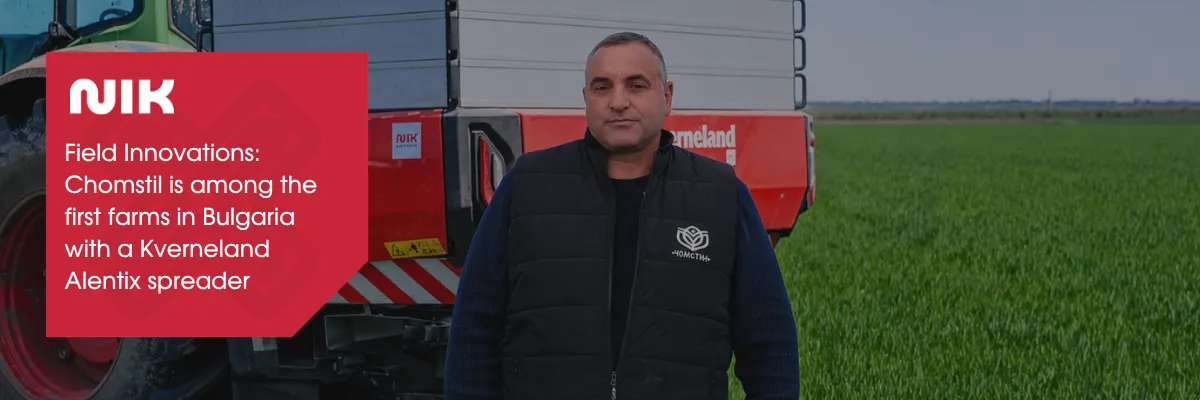
Field Innovations: Chomstil is among the first farms in Bulgaria with a Kverneland Alentix spreader
.webp)