What is Alexander Dimitrov's experience with Strip-Till?
ABOUT HIS EXPERIENCE WITH STRIP-TILL AND ITS BENEFITS, SAYS ALEXANDER DIMITROV, WHO CULTIVATES ABOUT 12,000 ACRES IN THE LAND OF THE VILLAGE. IVY.
To share the advantages and good practices it has implemented in its production, thanks to your tillage inventory in strips(known as Strip-till), we turned to an innovative-minded farmer from the area of the village. Brashlen, Ruse region, namely Alexander Dimitrov from PPK Brashlen.
On the farm of PPK Brashlen they have been practicing No-till for 4 years and from a total of 12,000 decares of arable area, today nearly 90% of the spring crops (corn and sunflower) are grown in strips — so called strip processing, usually — after intermediate cover crops.
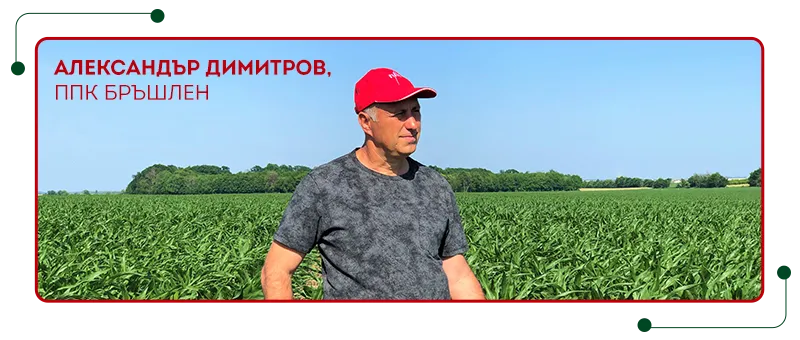
An interesting fact is that for the second year they also tried on this technology the cultivation of winter rapeseed.
What Alexander Dimitrov shares from his experience with strip-till technology:
1. What are the treatments that you carry out as part of Strip-till on the crops you cultivate?
- In springtails, we grow intermediate crops. After the harvest, we carry out sowing of the intermediate crop, and after it, we cultivate shallowly with a harrow, which can simultaneously cut the plant residues and incorporate them, together with the seeds, into the surface soil layer. At a later stage, that is, in the fall, in the developed intermediate culture, we process the strips through a Strip-till cultivator and simultaneously introduce phosphorus and potassium into them. We leave them like this to overwinter. In the spring, if the intermediate crop has not froze, we treat it with a herbicide, and then carry out the sowing with row-directed nitrogen fertilization.
- In rapeseed, we strive for strongly branching plants. We sow them in two rows, with a low sowing rate per square meter, which is a maximum of up to 30 seeds/m2. After the predecessor, we process the stubble with herbicide. The next action is to enter directly with a combined aggregate, which simultaneously processes the strips, carries out fertilization and sowing, in one pass.

2. At what depth do you carry out the treatment of the strips and at what depth do you carry out the fertilization?
- As with spring crops, so with rapeseed: in depth we process the strips up to about 23 cm. We apply the fertilizers with the cultivator about 18 cm (4-5 cm shallower than the depth of processing).
3. What are the advantages you see with Strip-till technology compared to conventional plowing technology?
- The first advantage is lower cost. At Strip-tillThe technology is much lower than the cost of conventional technology. For example, we need up to 4 times less fuel for processing compared to conventional technology.
- The second advantage is speed. We need less time for processing, and they are also carried out by relatively fewer mechanizers. Now we are also working with less inventory. At the same time, we also manage to comply with agrotechnical deadlines.
4. Did you do preliminary soil preparation before changing the technology?
- No, before the launch of Strip-till, we did not do one-time preparatory procedures. Annually, after sowing, we superficially apply bacteria with the sprayer. Also, annually we make soil analyzes and, where necessary, fertilize in the strips with granular phosphorus and potash fertilizers.
The third advantage is the higher soil temperature. We have found that in spring the soil in the autumn treated strips, at a depth of 10 cm, is 2 degrees Celsius warmer, compared to the soil in the untreated strips.

How many liters/ha of fuel does Alexander Dimitrov save annually from the implementation of Strip-till technology?
Download all the material here:
The experience of Alexander Dimitrov shows that the greatest benefit of growing crops in arable strips is the saving of fuel, labor and technological time for agrotechnical activities. These results are possible only with a well-chosen technique that will provide quality striped tillage, fertilization of fertilizer products to the desired depth and a reliable solution for sowing crops.
If you want to learn about the experience with strip-till from other farmers, or if you yourself have something to tell, you can join the specially created Facebook group “Good practices in Strip-till tillage”: https://www.facebook.com/groups/899643363827369/
Other articles
Field Innovations: Chomstil is among the first farms in Bulgaria with a Kverneland Alentix spreader
.webp)