What are the 5 principles of regenerative agriculture?
Regenerative agriculture is not new, and in recent years there has been increasing talk about its role in tackling climate change and improving the environment. In essence, regenerative agriculture is any form of agriculture aimed at restoring soil and minimizing the consequences of degradation processes.
The long-term implementation of intensive agricultural practices has led to the deterioration of the soil and its health, a decrease in its fertility, as well as its natural ability to sustainably support the entire ecosystem. As a result, yields are declining, and the need to invest more and more resources for the production of food and fiber is constantly growing.
Healthy soil is a complex ecosystem comprising countless microscopic organisms, all working in their own small niches, feeding on each other and exudates secreted by plant roots. The entire system is ultimately powered by living plants, while at the same time the system helps the plants grow and develop.
Because change happens slowly, it's hard to notice how badly we've damaged our soils. We are used to perceiving them as they are and it is difficult for us to imagine that they can be better.
However, it is enough to dig a hole in a pasture to see how different it looks compared to the soil of the arable fields. It is dark, crumbly, full of life and has a specific smell of healthy soil.
We already know what we need to do — not only to stop the deterioration of soil health, but also to reverse the process and start improving it.
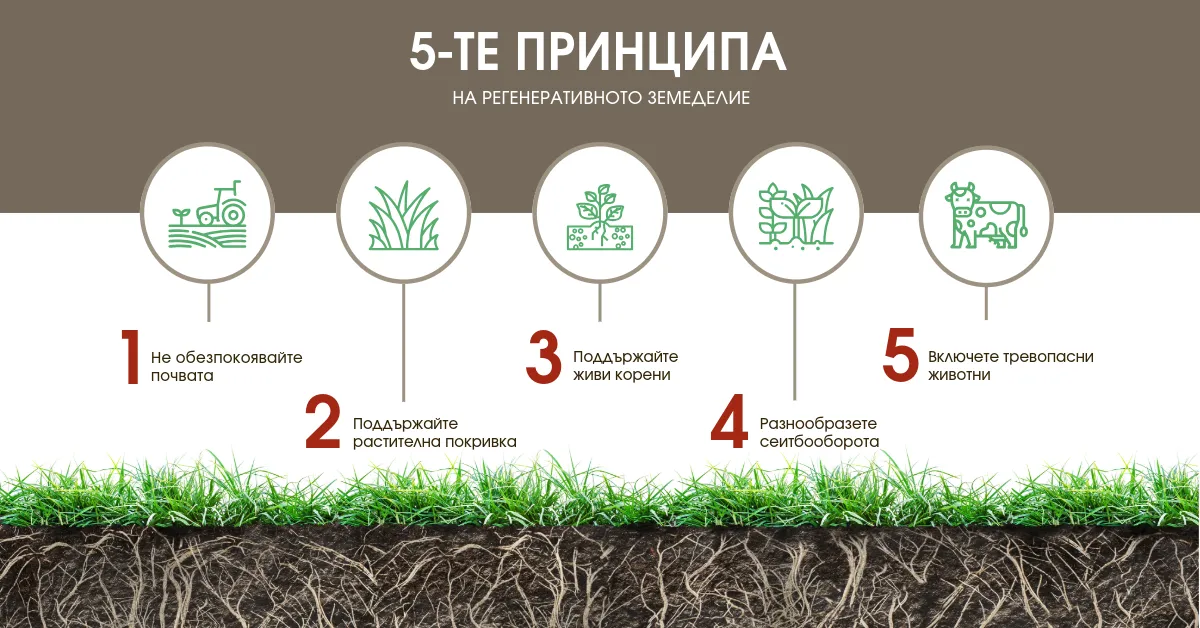
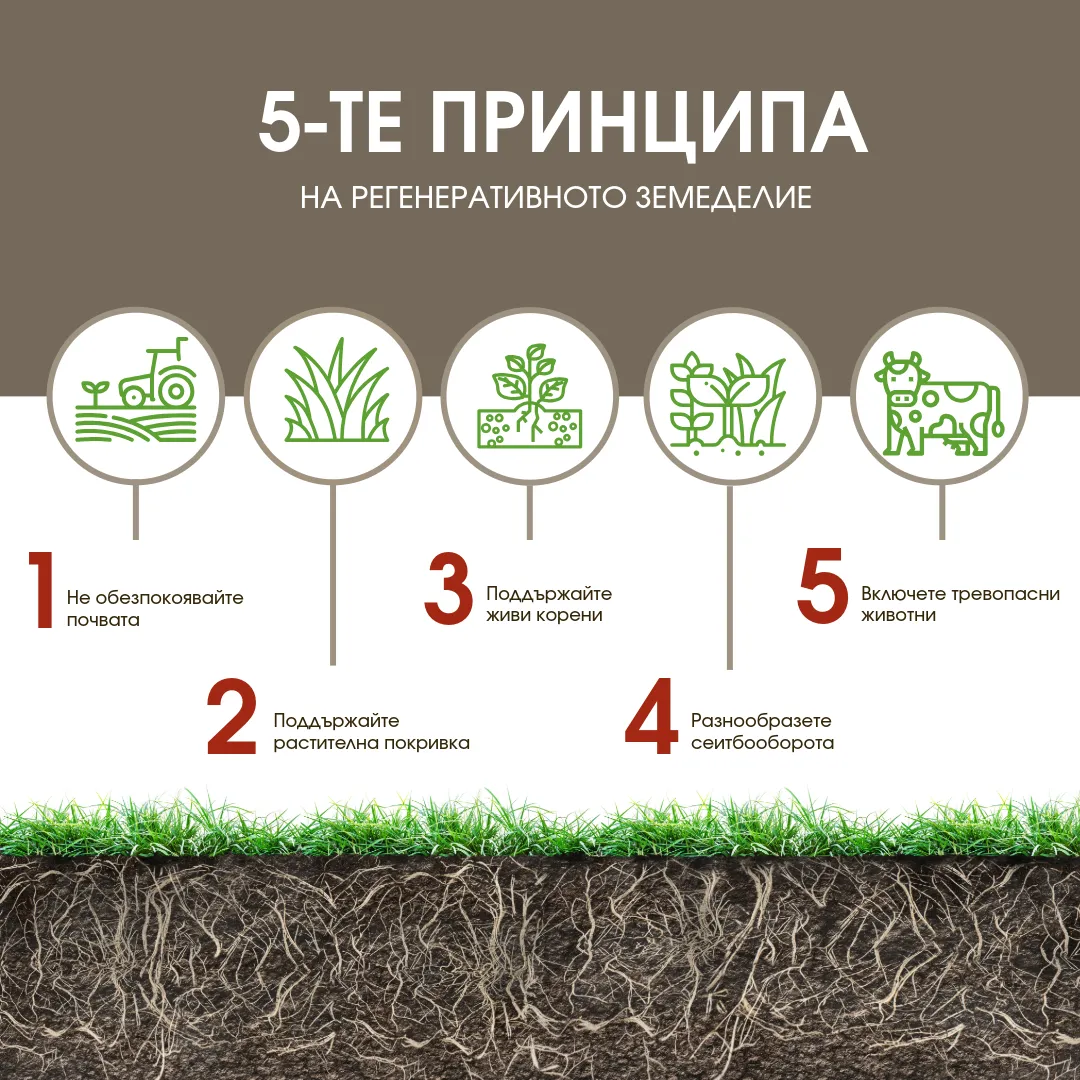
What needs to be done is synthesized in the so-called five principles of regenerative agriculture:
- Minimal mechanical disturbance of the soil
- Maintaining ground cover
- Living roots in the soil
- Variety in crop rotation
- Inclusion of herbivores
Minimal mechanical disturbance of the soil
The soil supports an intricate network of worm tunnels, fungal hyphae, and a labyrinth of microscopic air pockets surrounded by aggregates of soil particles. Breaking this network by plowing or by applying large doses of fertilizers and pesticides sets the system back.
Find out more about the no-till planter Agrisem mBoss for direct sowing - HERE
Maintaining ground cover
The impact of raindrops, scorching sun rays or frost damage the soil by destroying its structure and killing life on the surface and in the shallower layers. Maintaining a cover of growing crops or plant residues from cultivated crops can protect the soil and the billions of organisms in it.
Living roots in the soil
The presence of living roots in the soil is of enormous importance for feeding the microorganisms that underlie the soil food web — bacteria and fungi that provide food for protozoa, arthropods and higher organisms further up the chain. Living roots also support mycorrhizal fungi and allow them to develop. These symbiotic microorganisms play an important role in the nutrition of most plants, supplying nutrients and water to plants from places in the soil that the roots cannot reach. In return, the plants pay back by providing them with sugars.
Variety in crop rotation
The ideal is to provide a variety of crops at the same time as in nature. Monocultures do not occur in nature, and soil organisms thrive thanks to diversity. Growing two crops at the same time to be divided after harvesting has a positive result. Growing cover crops helps protect the soil while also providing food for soil dwellers in periods of not growing the main crops and traditional soil being left bare.
Inclusion of herbivores
The construction of pastures and the incorporation of animals helps the soil to rest for several years, at the same time it is protected by a plant cover and has living roots in it all year round. The presence of animals, in turn, contributes to the fertilization of the soil, providing food for both plants and its inhabitants. In order to have all the benefits, however, it is necessary that pastures be created from mixtures of crops, support the formation of dense cover, and the inclusion of animals be with controlled grazing.
Regenerative agriculture helps to stop the deterioration of soil health and start its recovery. It helps to reduce the negative effect of erosion, which robs fertility from our fields, contributes to the reduction of the inputs that are necessary to obtain enough food.
Improving soil health contributes to growing healthier and more resilient plants. Healthy soil better purifies the water we need. Healthy soil can absorb from the air and retain a large amount of carbon dioxide in it and thus reduce the negative effect on the climate.
For more useful content, subscribe to our newsletter!
Contact us
Other articles
Field Innovations: Chomstil is among the first farms in Bulgaria with a Kverneland Alentix spreader
.webp)