The 27-year history of the electrically driven seeder
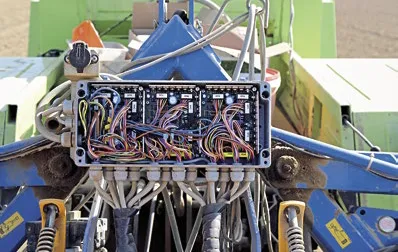
During the Agritechnica exhibition in 1993, 27 years ago, a small but innovative company Kleine presented the revolutionary electric drive of the single rows. What still unites grandfather with grandson, and in which areas genes have evolved, shows our technical time travel.
Hardly another agricultural machine can so little deny its origins after 27 years as Kverneland's synchro-drive. And this despite the fact that the beet planter has already undergone some changes in brand names and color changes, and its technologies are the basis of the modern e-drive solution, available not only in beet planters, but in the entire series of spring planters.
A bit of history:
At first, in 1990, the Unicorn-3 was a purely mechanical, yellow-blue planter at the Kleine machine-building plant in Salzkotten. Only three years later, however, the electric drive was introduced in it as a real landmark in the series.
Shortly before the introduction of 12 V DC motors Unicorn planteracquired its first external improvements: a redesign of the frame by a folding parallelogram, wheels following the contour of the soil and a number of other improvements to the mechanical drive. The series marks a great development in terms of details.
Despite these big leaps in development, one of the developers was thinking a step or two ahead: When replacing the chain drive with electric motors, numerous advantages would arise: smooth adjustment from the cabin of the distance between the seeds, the exclusion of single rows in a wedge, as well as manual and automatic switching of rail sowing. A great advantage turned out to be the smaller distance of the self-laying in the furrow.
After 1993 and this technological change, the planter changed many colors, but retained the essence of the electric drive and its advantages to this day.
Said and done. Kleine started with the development and used for this purpose engines from the production of ATMs. The planters developed with them with an electric drive on the single rows were named by Kleine synchro-drive. In the beginning, Kleine launched the first series at a similar price to mechanical machines. Today there is talk quite openly about this decision: “In the beginning, the costs were three times higher than for mechanical machines, but the success that came later compensated for them.”
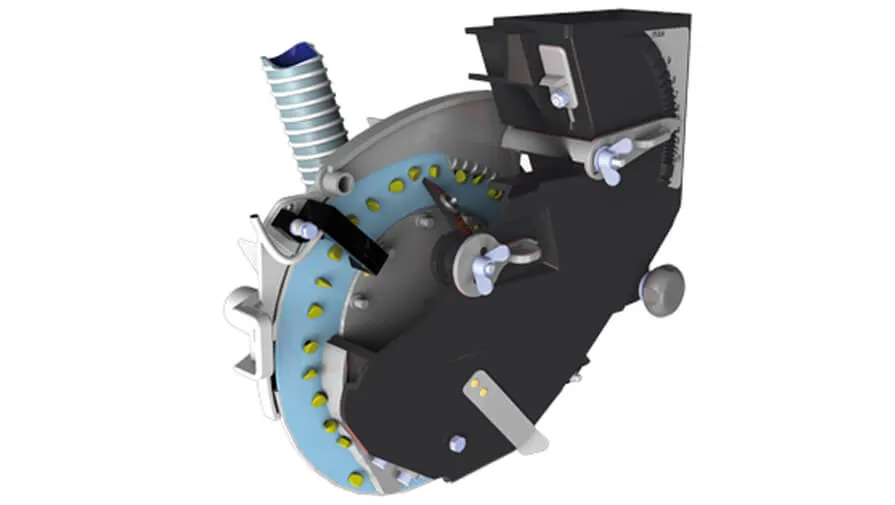
At the beginning of the new millennium Kleine enters into a strategic research, production and sales alliance with the Kverneland Group. Shortly after that, in 2000, the Kverneland Group acquired all the rights, as well as the production and further development of sowing solutions.
Since 2003, all planters have been produced at Kverneland's main plant in Zost, initially in blue-yellow. Shortly after that (in 2006), the machines went on sale already in red-yellow, corresponding to the Rau-Kleine trademark. Three years later, sales were transferred to the subsidiary Vicon, this time in the colors red-beige.
The end of 2018 is the last color change and since then the Unicorn planters have moved into the Kverneland production program. At the same time, the colors (red and white) of the corn planters are also updated, and the “synchro-drive” familiar to us until now is replaced by “e-drive”.
Meanwhile, machines continue to evolve. All the small details have also been reworked — from the markings to the parallelograms.
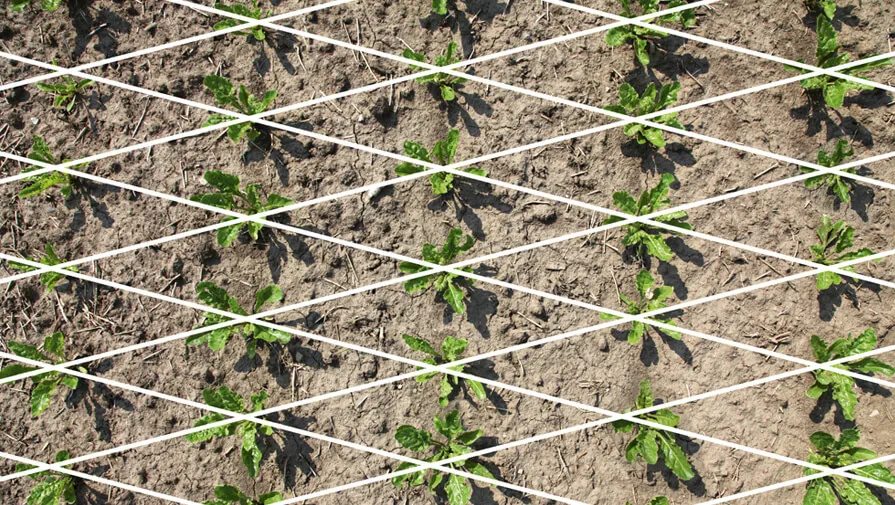
However, to this day, the seeding apparatus has remained the same. A novelty in electronic developments is GEOSEED, allowing sowing in a diamond or rectangular scheme. With this electronic solution, the concern will remain with a patent until 2029, still the only one on the market for a long time. Driven by the needs of GEOSEED, a new standard has been introduced in the control of the single rows, as well as in the overall electrical part of the machine — all signals from the single rows are fed to a central computer.
Undoubtedly, 27 years ago, the developers of the Unicorn synchro-drive achieved great success. And today one cannot fail to notice the origin, as well as the good foundations laid, on which all modern solutions for sectional control and smart sowing management step.
Let's trace the changes in the electrical part
Before
Now
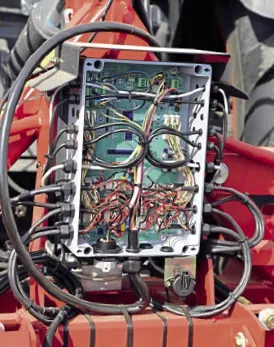
This is what the electronics looked like in the first synchro-drive planters.
Today's boards are four times smaller, but five times faster.
Before
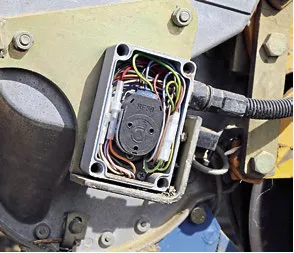
Now
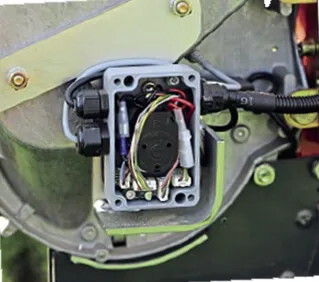
In the beginning, the generators of the tractor were required to provide 70 amps for 12 row seeders. Now 62 amps from the ISOBUS coupler are enough for up to 12 row planters.
Before

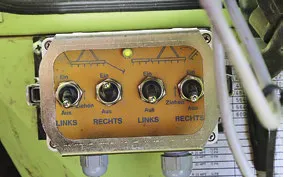
Now
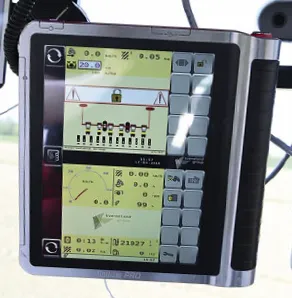
Until 2007, the Kleine terminal was an integral part of the synchro-drive. Folding is performed with a two-position switch.
Kverneland currently offers the third generation Tellus for ISOBUS control of all e-drive and planter functions.
Who is the man who invented the electric drive?
Reinhold Schulte worked for ten years as a developer at Kleine and in 1993 gave the idea for the electric drive of the seeder. Today, he is the owner and manager of a company for high-precision milled and turned parts, as well as system components.
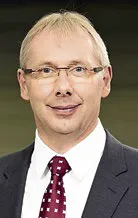
With his idea, Reinhold Schulte wrote history.
“Mr. Schulte, how did you come up with the idea of using an electric motor from an ATM?
— Before starting work in the development department of Kleine, I worked for more than two and a half years at Nixdorf-Computer, where I was able to gather a lot of experience in terms of the interaction of mechanics, electronics and software, as well as in terms of ATMs. As the son of a farmer, in my new position, all the advantages of an electric drive went through my head. Fortunately, I knew the machines well.”Unicorn”, since even as an apprentice in the profession of mechanic of agricultural machinery I worked at Kleine.
How did your management accept your idea?
— Very different. Some colleagues were quick to get excited. Others saw no potential. Sometimes I had to firmly defend my concept. Despite the skepticism, we developed a six-line prototype, which in 1993 was put into the field and in 1995 was already in serial production.
What were the biggest challenges in the development process?
— The mechanical requirements were quickly met after we replaced, for example, the sliding bearing in the seeding heart with a radially aligned bearing. We also quickly installed the clock generator to the support wheel. Logic required a great deal of mastery.
— Today Kverneland offers sowing in a diamond pattern. Did such ideas exist then?
— Surprisingly, yes. Already at the first concepts, I sketched the potential for cross-row tillage of beet plantations. However, the accuracy of the GPS systems at that time was not enough. However, the advantages of excluding rows in a wedge or less spacing between seeds were real progress.
— What other future developments can you imagine with this drive?
Theoretically, there are a lot of possibilities. For example, recording each beet seed laid to take into account weed control or fertilization individually — in practice this is another data challenge. In reducing the cost per unit of output of electric drives, I generally see great potential for sowing other crops, such as corn and sunflower, for example.
...
It was a short account of the long journey that the electric drive of the seeders found today in almost every Kverneland Optima spring planter has come.
Today called e-drive, it carries the heart and ideas of an innovator and with them helps to achieve better results in spring sowing, thanks to high-speed models such as Optima SXand classic models such as Optima HD. A patent, an invention of a talented young engineer, which still guarantees quality sowing to hundreds of farmers all over Europe.
Other articles
Field Innovations: Chomstil is among the first farms in Bulgaria with a Kverneland Alentix spreader
.webp)