Sustainable strategies to protect against plant diseases and healthier crops
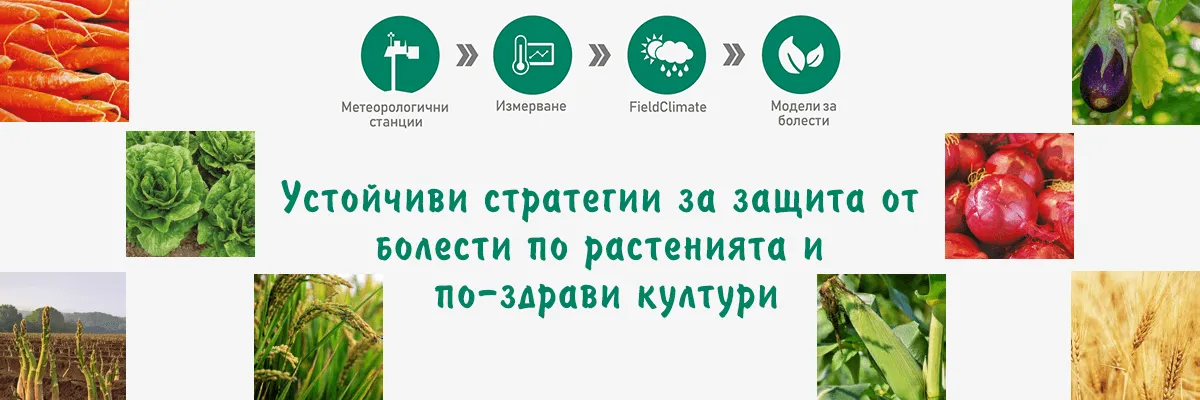
Over the past few years, the impact of climate change has been increasing rapidly. It is an important factor at all stages of crop development and forces farmers to change and adapt their actions. They must look for new management strategies to make their agricultural actions both environmentally and economically viable, with a focus on return on investment.
Given the complex interactions between plant, soil, and environment, disease prediction and optimal fungicide application time is essential.
With a well-thought-out approach, farmers can increase crop yields with less impact on the environment, while maintaining food quality.
When do fungal diseases occur?
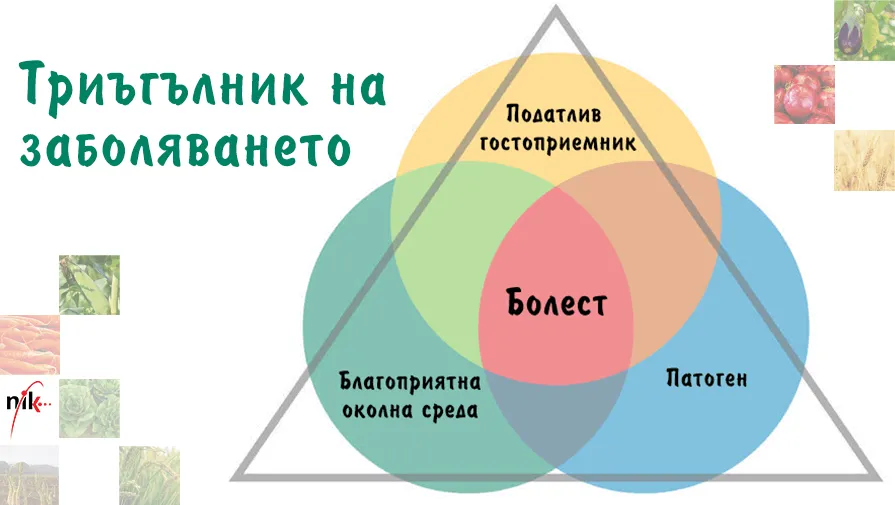
In the presence of three factors:
- susceptible host
- favorable environment
- Pathogen
The fungal pathogen must come into contact with a susceptible host plant under favorable environmental conditions. This event is summarized in the disease triangle.All three factors must be present at the same time for a disease to occur.
Severity of the disease
The severity of the disease depends on:
- Plant variety (some hybrids are more sensitive than others)
- Inoculum/number of infectious spores (crop rotation)
- Environmental conditions (for example: heavy rain spreads the spores over a larger area, prolonged wetting time of the leaves)
- Crop management (overwintering on crop residues, plowing)
The main factor in infection with the fungal pathogen is weather conditions.
Humidity in the form of rain, high relative humidity, leaf humidity, dew or fog, favor the disease, and the higher temperature in these wet periods accelerates the infection process.
Disease monitoring
Weather stations equipped with sensors for rain, relative humidity, leaf humidity, solar radiation, soil parameters and temperature determine risk periods for infection in the field every hour.
With this information, fungicide applications can be optimal.
For example, fusarium disease Fusarium Head Blight is influenced by the history of the field (number of spores available) and by the climatic situation. It will not arise if the climate is not favorable during flowering.
But if there are optimal conditions for infection during flowering, the flower will be infected, and the disease will lead to deformed grains and a concentration of mycotoxins in the culture.
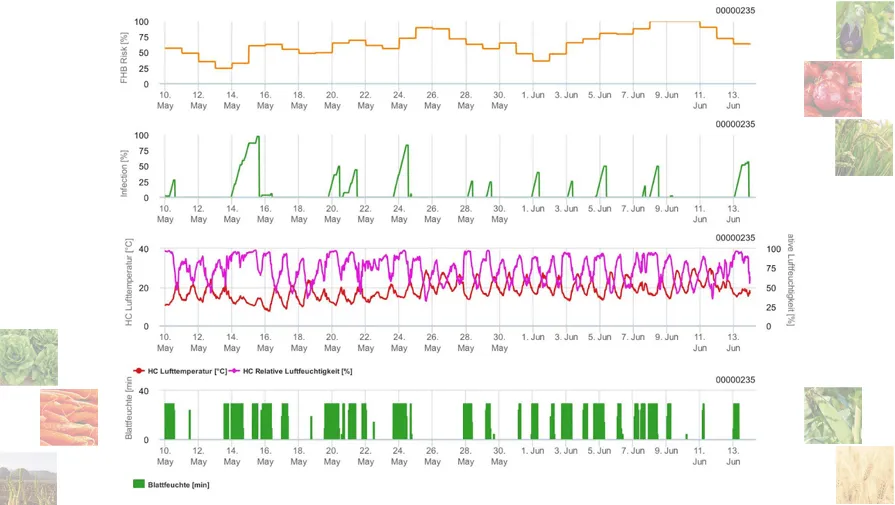
Graph 1:Forecasting risk periods
Graph 2:Determination of infection dates in the field based on temperature, relative humidity, leaf humidity (the last two graphs are with measured data from sensors from the weather station).
If 100% infection is determined, optimal conditions are persistent long enough to infect the bloom.
Recommended solutions for disease monitoring
A wide range of hardware solutions under the iMetos brand of Pessl Instruments provide efficient and cost-effective environmental measurements.
All measured values can be combined with a local weather forecast and be available in near real time on the platform FieldClimate— amount and probability of precipitation, temperature, relative humidity, etc.
We remind all current users of the platform that the current Internet address to the platform is: situ https://ng.fieldclimate.com/.
We recommend the following model weather station:
Advantages and capabilities of iMetos
- Optimization of time and money through the use of online monitoring
- Processing under the most appropriate conditions
- Ensuring the most favorable conditions for the development of crops
- Monitoring in order to adapt technical treatments to climate change
- Making the right decisions at the right time based on a detailed weather forecast
- Production optimization through the use of planning tools available on the platform
- Information on the right time for sowing
- Information on the right time for plowing
For more information on Pessl Instruments' iMetos weather stations, please contact our teamor write to us at: office@nik.bg
Other articles
Field Innovations: Chomstil is among the first farms in Bulgaria with a Kverneland Alentix spreader
.webp)