Nitrogen feeding of corn - is it justified to do it?

In recent years, it has become increasingly popular to do nitrogen fertilization of corn once - before or during sowing. Thus, the additional costs and time of carrying out feeding during the growing season are saved.
However, is this a good practice and what risks does this approach entail?
Different crops need different amounts of nutrients to form the yield. In addition, they also absorb them in different amounts during their development, such as there are phases that play a key role in the formation of yield. If it is precisely in these critical phases that the plants do not have enough nutrients in a digestible form, this inevitably affects the yield.
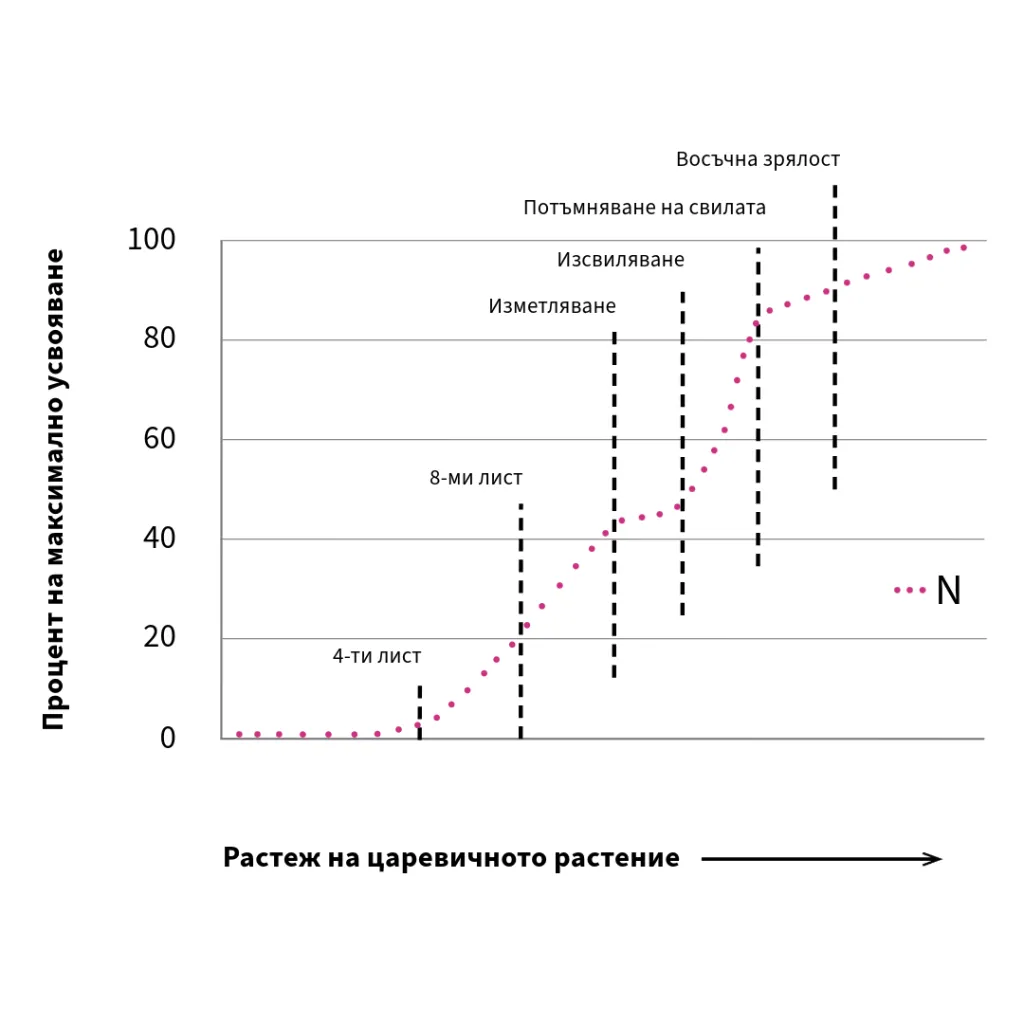
As can be seen from the figure,Corn needs small amounts of nitrogen in the early stages of its growth. As development progresses and enters the period of intensive vegetative growth, nitrogen absorption increases significantly. However, by the time of sweeping, it absorbs just over 40% of the nitrogen needed for all vegetation, and the remaining amount is needed after this phase. It is good to keep in mind that less than a third of the nitrogen needed by the end of the growing season is obtained from reuse (reuse) by aging tissues. This means that at the time of the onset of the sweeping phase in the soil there must be a sufficient amount of nitrogen in a digestible form. And while phosphorus and potassium, being relatively immobile in the soil, we can provide pre-sowing and that they are available when the crop needs them, the situation with nitrogen is quite different.
Nitrogen is very mobile, and in heavy rainfall, such as occurs in spring, it moves (washes away) to the deeper soil layers, out of reach of the active root system and corn is subjected to nitrogen starvation. For this reason, if we want to ensure the potential of corn for high yields, it is good to keep in mind the critical phases in which it must be provided with sufficient nitrogen and be ready to carry out feeding when necessary. And in order not to have to guess whether and how much nitrogen is in the soil, and whether there are already deficiencies in the plants, it is most expedient to regularly examine the soil and plants in the laboratory.
The results of laboratory analyzes can most accurately guide us what our strategy should be for optimal nitrogen nutrition of the crop in the respective phase of development.
When and how it is correct to take the samples, you can see here.
For more useful content, subscribe to our newsletter!
Contact us
Other articles
Field Innovations: Chomstil is among the first farms in Bulgaria with a Kverneland Alentix spreader
.webp)