How to achieve maximum efficiency with the right correction service

Have you ever wondered what happens behind the scenes while your tractor's navigation system keeps you in the right lane?
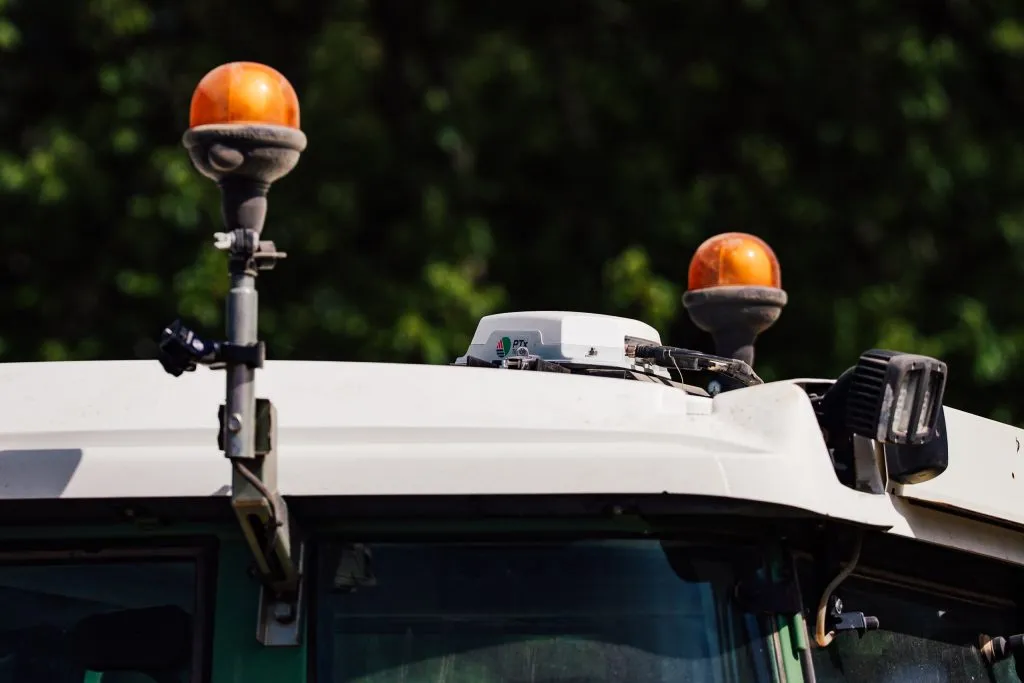
The heart of the navigation system is the controller mounted on your cab, also known as the GNSS receiver. Depending on the model, the receiver uses multiple satellite signals to determine your exact location through position, speed, and time measurements.
The correction service — whether free or paid — communicates with the receiver and feeds data to the system, indicating which direction the tractor should move in order to stay on the preset line. The most accurate corrections, which are usually subscription-based, correct errors in satellite signals to ensure consistently precise operation. Based on these adjustments, the autopilot automatically adjusts the wheels.
With so many interconnected elements, it becomes clear how important each component of the navigation system is.
Why are adjustments important?
Having trouble with intermittent or unreliable correction signals? It's time to check what type of adjustments you use and what your receiver supports.
Free remediation services are often good for more general farming activities, but interruptions are also obtained that are not always immediately noticeable. This can lead to gaps or overlaps in processing. Here is an overview of the main types of correctional services and their advantages:
RTK (Real Time Kinematic Method)
- Accuracy: up to a centimeter in the range of a base station
- Transmission via radio or mobile network
- Base station installation required
- A modem is required for a mobile signal
- Accuracy decreases as you move away from the base station
- Mobile connection affects performance
VRS (Virtual Reference Station)
- Accuracy: centimeter
- Dependence on available network in the area
- No base station required — uses mobile internet and a network of stations
- Requires subscription, modem and mobile plan
- Wider coverage than RTK
- Mobile connection also affects performance
RTX (Extended Real-Time Correction)
- Accuracy: from centimeter to meter anywhere in the world
- Accessible via satellite and internet; does not require a base station
- Depends on subscription plan and available connection
- Mobile internet requires modem and plan; satellite connection — subscription
- The “connect” time is longer compared to RTK, but new receivers reduce it
Which adjustment is right for your farm?
The choice depends on:
- What accuracy do you need (depending on cultures and activities)
- Where is your farm located
- Does it have good mobile coverage
- Budget and readiness for additional investments
Accurate subscription services are best for specialty crops like potatoes where the plant is not visible. Consultation with the NIK team will help you in choosing.
The importance of the receiver
Remember that the type of receiver also matters. Older models support fewer satellite signals and have lower computing power. Modern receivers have improved error avoidance features such as:
- Delays from the antenna at different angles
- Reflected signals leading to wrong position
- Satellite errors due to deviations from orbit
For example, the Trimble NAV-960 PTx controller monitors multiple satellites (GPS, GLONASS, Galileo, Beidou, and QZSS) and uses an inertia sensor for better positioning and control. The ProPoint GNSS function ensures operation even with partially blocked signals (from trees, buildings, etc.) and increases the smoothness and durability of the connection. IonoGuard technology offers protection in solar storms, ensuring maximum uptime even in difficult conditions.

In conclusion
Time in the field is your most valuable resource. Do not lose it because of an old receiver or an inappropriate correction service. Ensure accuracy that meets your needs.
————————————————————————————————————————————————————————————————————————————————-
Need help choosing a correction or receiver, contact us!
Other articles
Field Innovations: Chomstil is among the first farms in Bulgaria with a Kverneland Alentix spreader
.webp)