How will autonomous machines change agriculture?
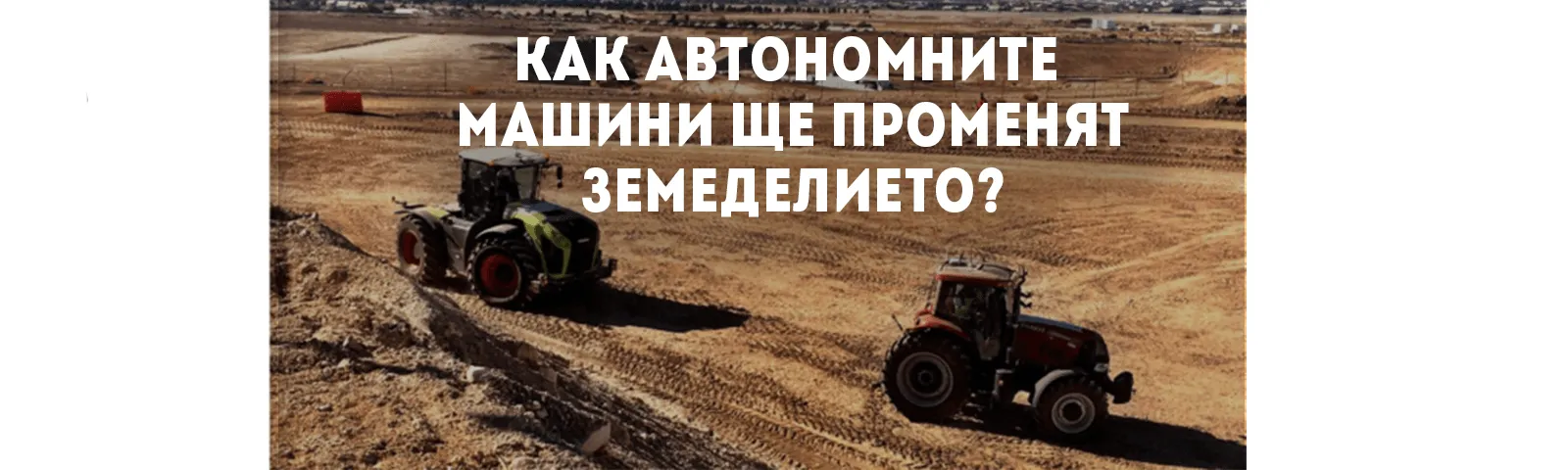
Since the tractor replaced the animals in the field, agriculture has not stopped developing and walking the path to full automation.The introduction of auto-steerby Trimble is perhaps the most significant step towards minimizing human intervention in many agricultural processes and facilitating the operation of the flight.In recent years, there has been an increased production and supply of technologies that are part of the concepts of complete autonomy in the field of agriculture and a reduction in the role of operators in some agricultural processes. As we see autonomous machines perform more and more agricultural tasks, it is logical to ask ourselves:How will this autonomy change agriculture?
Future solutions
The idea of future farm management is that it will be done easily and quickly from the comfort of your home or office. All this is achievable, but it will take more time to generate the appropriate solutions and technologies. It is expected that these solutions will be based on and similar to auto-steer and NextSwath technologyfor curling at the end of the row. Thanks to them, this progress will be achieved and the optimization of time and costs in the farm.A great contribution to the development of autonomy in agriculture is the Leader-Follower program developed by the American company Trimble. With it, a driverless tractor can track the movement of another tractor that is in front. This technology will be applicable mainly to large farms where equipment is carried out in parallel. The plowing process is an example of a suitable agricultural event in which to use this following of the tractor in front. In this type of autonomy, the perimeter in which work is carried out is determined and at what distance to be the other machines from the main one that is steered.A similar demonstration to track a tractor by another, in which there is no operator, was made on the annual conference of the American market leader. https://www.youtube.com/watch?time_continue=2&v=6wiEaJtnDsE
Autonomy in the automotive industry in support of agriculture
In general, agriculture has a simpler operational area compared to other industries in which autonomous machines are used. Let's take an example of a car. In it, autonomous machines face challenges such as a large number of other machines on the roadway, other road users, a large number of highways, roads and others. Unlike autonomous machines in agriculture, which have a far wider range of work and fewer obstacles.However much the differences between the two industries, progress and innovative solutions in one can be applied in the other.We are witnessing huge investments in autonomous vehicles and subsequent positive results such as high optimization of costs. Taking into account that the operational area in agriculture is simpler, autonomous solutions and technologies from the automotive industry will be able to be implemented much faster.Trimble has also made a great contribution to the development of autonomous vehiclesThe RTX technology offered by the American company has been implemented in Cadillac brand cars, and the division Company XYZ has a simulation engine. It allows pre-testing of autonomy algorithms.Applanix, another division of Trimble, is involved in the development of autonomous solutions for military machines that face similar challenges as agricultural ones. In both areas, machines are subjected to harsh operating conditions such as dust and uneven terrain. We see that agriculture can borrow much of the progress in the other two areas - automotive and military. But here there is one important point where special attention should be paid. In agriculture, a machine is not only horsepower and size. In this area, the quality of processing, which is achieved with the autonomous agricultural machine, is important.
Trimble and future autonomous solutions
Although Trimble has been developing autonomous technologies for more than 15 years, the American company does not stop there. With various projects and acquisitions, the market leader seeks to create an even more complete and complete picture of the area in which “smart” machines operate.One of the projects is SIS. It is an information system, thanks to which a soil picture of a field can be drawn up. Thus, the types of soil, where and how each species is located, the stock of nutrients, etc., can be traced. With this information, even more precise operation of the autonomous machine can be guaranteed.In turn, thanks to the acquisition of Muller-Elektronik, it will be possible to achieve not only better control over the processing of the field, but also obtaining useful information. Thus, the quality of the agricultural operation will be at the level, regardless of whether there is an operator in the cabin or not.
How autonomy will affect farmers and the industry as a whole
Although autonomy means that we will see fewer people in the machines on the field, it does not mean that their importance will diminish. Nor that farmers will be less involved with their farms.There will simply be a change in roles in agriculture. Let's give a simple example.At the moment, if a farmer is engaged in a machine — its management, monitoring work, loading and so on. With the introduction of technology Leader-Follower, he will have the opportunity to drive one machine, but lead two or three more. Another operator may be in charge of refueling them and refueling them with raw materials such as seeds or fertilizer if necessary. This will allow everyone involved in a task to monitor its quality and precision, not just its execution.
More benefits of autonomous solutions
The benefits of autonomous solutions will of course begin with reduction of operator fatigue and stressand respectively increase its productivity.The new solutions will also affect labor costs. This includes the costs of salaries and insurance, as well as those related to finding the right personnel to carry out an operation.Manufacturers not only face the challenge of finding people who want to be employed in this field, but also the increasing increase in minimum income and insurance by the legislature. Hence the higher cost of output and final goods.The reduction in production costs will also have a beneficial effect on the portfolio of end users with a reduced price of the goods that reach them.New autonomous solutions can also help in reducing waste of production and efficient use of the resources invested.
How farmers can prepare for future autonomy
The good news is that in terms of infrastructure there is nothing specific that needs to be created. In the short term, autonomous machines will be integrated into existing work processes, so the hardware and processes that farmers have will remain the same.Another part of preparing for autonomy is inspecting all fields and identifying possible obstacles. They must be removed or at least delineated so that the autonomous machine can be aware of them.
Other articles
Field Innovations: Chomstil is among the first farms in Bulgaria with a Kverneland Alentix spreader
.webp)