How does a farmer save 83% detergent when spraying stubble?

Depending on the agricultural practice chosen on a farm, tillage may be conventional, reduced or completely omitted /no-till/. In all cases, however, when controlling weeds after harvest, spraying with herbicides is mainly relied on.
Traditionally, herbicides are applied evenly over the fields, regardless of the level of weeding. However, this flat rate of application of a preparation is associated with putting an amount where there are no weeds, and with a correspondingly higher cost.
How, then, can a saving of 83% of the applied herbicide be achieved in this process?
We find the answer in an example from the practice of our client who, through the SmartStricker selective spraying technology from CarbonBee, not only eliminated weeds, but was able to reach this savings of nested herbicide.
The agricultural practices carried out on this farm are aimed at minimal treatments and what lies ahead is the sowing of cover crops. This also requires timely dealing with weeds. The dynamic economic situation in recent years, on the other hand, provokes weed control processes to be carried out with optimized costs and by achieving savings in each operation.
The solution
The farmer, who cultivates about 12,000 acres in the Ruse region, decided to trust selective spraying. The harvest on the farm has passed in early June, and the logical continuation is the treatment of stubble against weeds.
The weeding that was observed was within normal limits, but heterogeneous in terms of weed size and species/presence of so-called self-seeding/.
Weed treatment was carried out with an Apache self-propelled sprayer equipped with the SmartStricker selective spraying system.
When processing stubble, the Green on Brown method was applied. In this farm for the first year, selective spraying is carried out, which also provokes the comparison of the types of models in it:
- modulation spraying/when not only the nozzles are switched off and on, but also the injected dose of the preparation is controlled/
- spot-spraying/when the nozzles are switched off and on relative to whether there are weeds or not/
Result of selective spraying
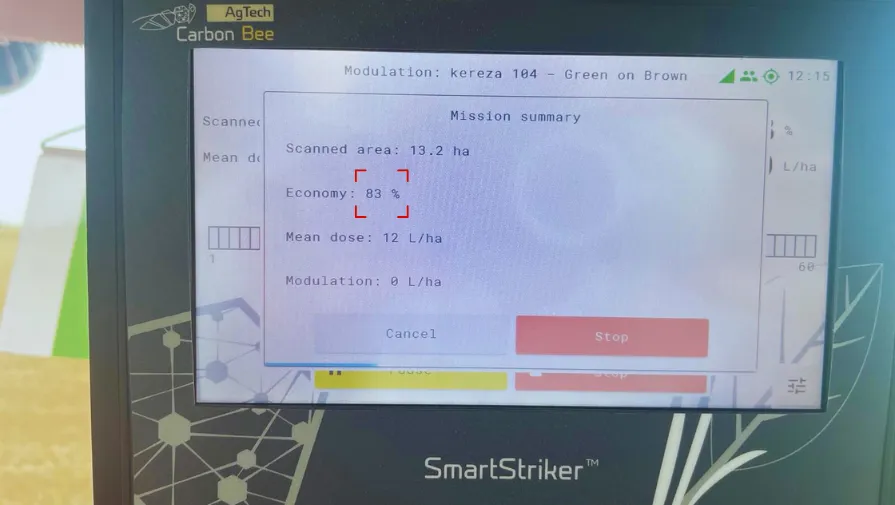

As can be seen from the pictures, the selective spraying with the SmartStricker system achieved detergent savings in the range of 75%-83%/depending on the selected work model/.
This saving does not compromise and is not at the expense of spray quality and weed elimination success rate.
What led to this successful outcome?
Thanks to the selected SmartStricker selective spraying system, these high herbicide saving rates have been achieved, which is also a key advantage of this technological solution. Namely optimization of the applied preparations for plant protection and environmental protection, through more sustainable agriculture and operations.
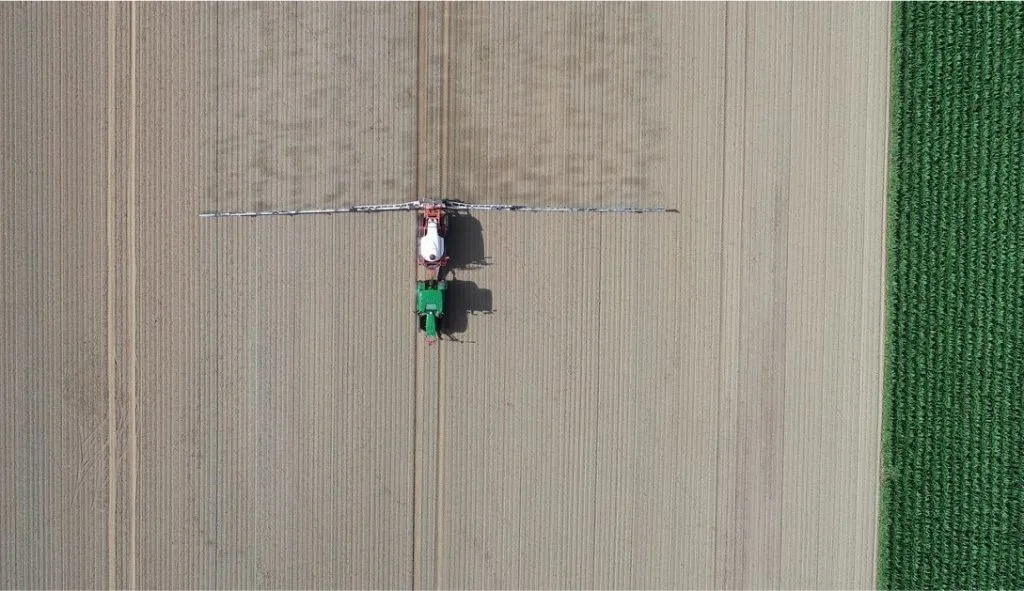
How does the selective spraying system work?
At the heart of the effective operation of SmartStricker is the real-time scanning of the field. The sensors installed every 3 meters each have 2 cameras - multispectral and hyperspectral.
Thanks to the built-in artificial intelligence, the system treats only the targeted weeds and applies detergent in the right amount and place.
Real-time spray tracking and actual detergent savings are visualized on a terminal in the cabin.
Installed on a sprayer — when installing a new or second-hand machine, the amount of chemicals applied in the field is drastically reduced in the following possibilities:
- Green on Brown when all green plants in the field are treated
- Green on Green, when treating weeds in an already developed crop
- Variation of Green on Green in row crops where everything but the main crop is treated
- Double douse — when the system sprays the entire field with a flat rate, applying a double dose only to the weeds
- as well as herbicide and nitrogen modulation
In addition to optimizing the amount of preparations used and resources invested, the system also helps to reduce the phytotoxicity of plants in the field, which leads to an increase in the quality of production, regardless of the type of crop.
Other articles
Field Innovations: Chomstil is among the first farms in Bulgaria with a Kverneland Alentix spreader
.webp)