Benefits of variable fertilization on the farm of Venelin Delgiansky
Variable fertilization (VRA) is at the heart of precision and sustainable agriculture, and has also proven itself in recent years as one of the right fertilization strategies. The technology is associated with a number of profitability benefits. The example we are telling you about today is from the farm of Venelin Delgianski — one of the farmers who trusted the AgroBalance-VRA service.
AgroBalance-VRA is a service with which farmers receive accurate and detailed information about soil nutrients. It includes automated sampling and analysis of samples in an accredited laboratory. Based on the results, the agronomist prepares recommendations and maps for variable fertilization for each block.
In the fall of 2023 Venelin Delgiansky decides to try the AgroBalance-VRA service. Sampling was done on two blocks on which sunflower is to be sown. It is clear that in both fields there is a variation of phosphorus and based on the soil analyzes a recommendation and maps for variable fertilization (VRA) were prepared. The end result is a reduction in the amount of phosphorus they would normally bring into the same fields by 80%.
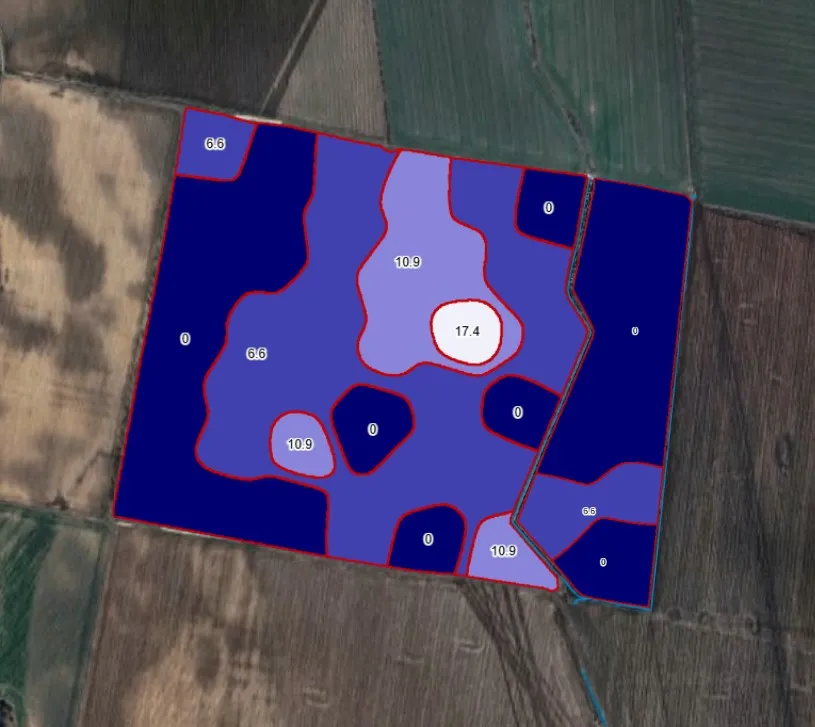
VRA phosphorous fertilization cards (TSP (kg/ha))

*TSP (Triple Superphosphate). For standard fertilization, a norm of 20 kg/ha of TSP is taken into account.
During the growing season of the sunflower, additional monitoring was carried out, and samples were formed, both from the soil and from the plants. They are selected in places of the field that were at zero norm and where fertilization was carried out. The data shows the following:
- in the case of soil, the phosphorus stock in the non-tilled areas remains higher and confirms the initial results, and the stock in the fertilized area has increased slightly, remaining in the low range;
- in the case of plants, in the area where phosphorus has not been imported, the plants are equally protected with that in which it has been imported.

Areas from which the samples were formed


In the next season (2024-2025). variable fertilization and the AgroBalance-VRA service are already applied on an area of 10 thousand acres. The trend established in the first year is maintained and again, savings have been realized compared to standard fertilization practices on the farm.
With varying reserves of phosphorus in the soil, as there are on this and many other farms, variable fertilization is the most optimal option for choosing technology. The VRA allows areas with high and very high stock not to be fertilized, while where the stock is low — to be approached with a higher rate.

Zones with different phosphorus stock (P2O5)
Today, based on the experience of two seasons, Venelin decided to include in AgroBalance all the areas he manages. And in terms of service, he shares:
The times of romance in agriculture ended about five years ago with climate change and of course with the geopolitical situation in the Black Sea region. This led to a sharp drop in revenue in grain production. We as producers cannot influence these factors, but we can reorganize our production to make it more profitable, namely by optimizing costs, but not at the expense of lower yields. Soil analysis and recommendations from Eurofins Agro Testing not only optimized our fertilizer costs, but also helped us to be even more precise in what we do. We pay attention to every detail, because in order to have a result of everything you have to be precise in every process in the field. We also stopped being shamans and soothsayers in the fields and working blindly. In our business, every single penny, and from 2026 and euro should be invested wisely, and it is much easier to make decisions when you know what is happening in the soil, because it is the main resource in our production.”
Other articles
Field Innovations: Chomstil is among the first farms in Bulgaria with a Kverneland Alentix spreader
.webp)