An important success factor: the correct information from the agricultural field!
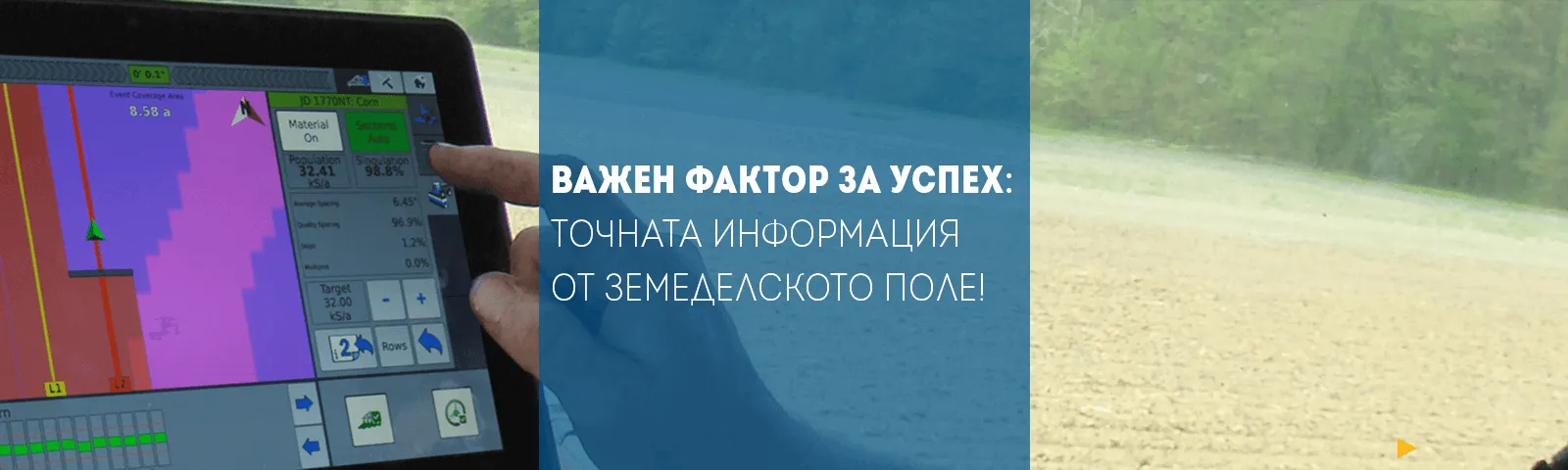
Why is accurate and reliable information from the agricultural field needed?
This is the question that faces many farmers, and we will try to give a clear answer and guidance to all who wish to improve their yields and achieve easy cost optimization.To do this, we will present the expert opinion of Devon Lees, who has over 14 years of experience in precision farming at Trimble. According to Lis, accurate yield information plays a fundamental role in increasing the profitability and productivity of a farm.Of course, there are other factors that influence the desired results, but without clear data on yield, farmers can make the wrong decisions about the conduct of various business activities.The role of accurate yield data is becoming increasingly important. greater in solving the problem of different productivity zones in one field. In order for the farmer to take the right steps to improve the productivity of each section of his field, he must have accurate information. This is the only way to achieve more efficient farm management.The measures that can be taken on the basis of this information are different and specific to each farm. Areas that have very low productivity can be completely removed from the arable area. For other areas, it may be necessary to reduce the amount of inputs, which would not change the yield anyway. It is not bad to also consider soil samples to analyze problem areas.But in order to take correct and timely measures, farmers need to have the information that can show them what is actually happening with the crop.The yield data is the report card that shows what the result of the year is and what happened in the field. But we must be aware that these data may not be so accurate. Their imperfection may be due to a number of reasons such as overlaps, incorrect calibration, etc. Either way, this data is important and of high potential, but sometimes of poor quality.
The problem
The accuracy of the data depends largely on how carefully the combine operator registers the yield data from its display. Most displays require operators to perform so-called calibration themselves. That is, to measure the actual amount of yield for a given section of the field. This is most often done by pulling the grain and the subsequent introduction of the weight into the display. This calibration should be carried out at the time of harvest for each individual crop and take into account other specific characteristics such as moisture and seed type.If for some reason (most often lack of time) this calibration is missed, then the harvest data will not be completely accurate. Especially if you are working with more than one uncalibrated combine.The result?A bunch of meaningless data that does not reflect the real situation on the field.Other reasons that can lead to data inaccuracy can be: Loss of signal — this is how there is a difference between the registered place of harvest and the real thisGPS and sensory inaccuracyProcessing overlap
The solution
According to Devon Lees, some farmers prefer to “clear” their harvest data manually. However, this is quite time consuming and laborious. Others, however, are turning to innovative tools to collect yield information. Below we have included a list that farmers can use when choosing a tool that can most accurately filter data from yield mapping systems.In summary, the tool should be able to:
- It works with all the mining data read by the TrimBleag software coming from the most common precision farming display.
- Automatically removes invalid data related to sensor errors, equator deceleration, topographic errors and overlaps.
- Easy correction of missing/incomplete data due to multi-combine harvesting
- Providing the ability to correct the data using the data of the real yield.
- Enabling the export of data for the following types of mining:Calibrated yield- includes all adjustments and adjustments applied to the raw data layer.Normalized yield- puts all yields on a scale up to 100, where 100 represents 100% of the average yield for each field. This method makes it possible to easily compare yields over the years, even when there was a different crop.
Other articles
Field Innovations: Chomstil is among the first farms in Bulgaria with a Kverneland Alentix spreader
.webp)