Abiotic stress in corn - what to do?

Plants are living organisms and as such are dependent on environmental factors. As agronomists, we are often asked what are the ways to deal with the effects of bad weather conditions. Countering them is often a real challenge, but knowing them will certainly help to better manage on-farm practices.
In conditions of stress, the priority is survival, not growth.What does that mean? Under the pressure of extreme phenomena, crops seek to complete their biological cycle as quickly as possible, which inevitably compromises the quantity and quality of the yield.
Low temperatures and unfavorable soil conditions
Problem.
Low temperatures, during the early phases of corn development, are the cause of the so familiar crimson staining syndrome. During photosynthesis, plants produce sugars that serve as energy for the growth of roots and green parts. However, under the action of low temperatures, their growth slows down. As a result, sugars accumulate in the leaves and the pigment anthocyanin is formed, and the leaves acquire a purple color.
Purple leaf color can also occur with too much compaction of the soil, as it limits the penetration of the roots in depth and thus makes nutrition difficult. This is an effect that we often see at the edges of the field, where machine traffic is more intense, as well as in blocks with minimal or missing treatments.
Anthocyanin staining is also a common symptom of phosphorus starvation in plants. By analyzing the soil, we can easily track the stocks of the element and, if necessary, correct it by means of fertilization.
Solution.
Studies show that tillering in the early stages of corn development does not have a negative effect on the yield, and as temperatures rise, the crop overcomes the stress that has arisen on its own. If the anthocyanin hue is the result of phosphorus deficiency, fertilization should be started. Otherwise, the shortage can have negative consequences on the development of plants.
What do we advise you?
Test the soil before each season. In addition to the nutrient stock, it is important to check the compaction in the blocks where you plan to sow corn. Such a practice will give you an advantage in making decisions during the growing season.
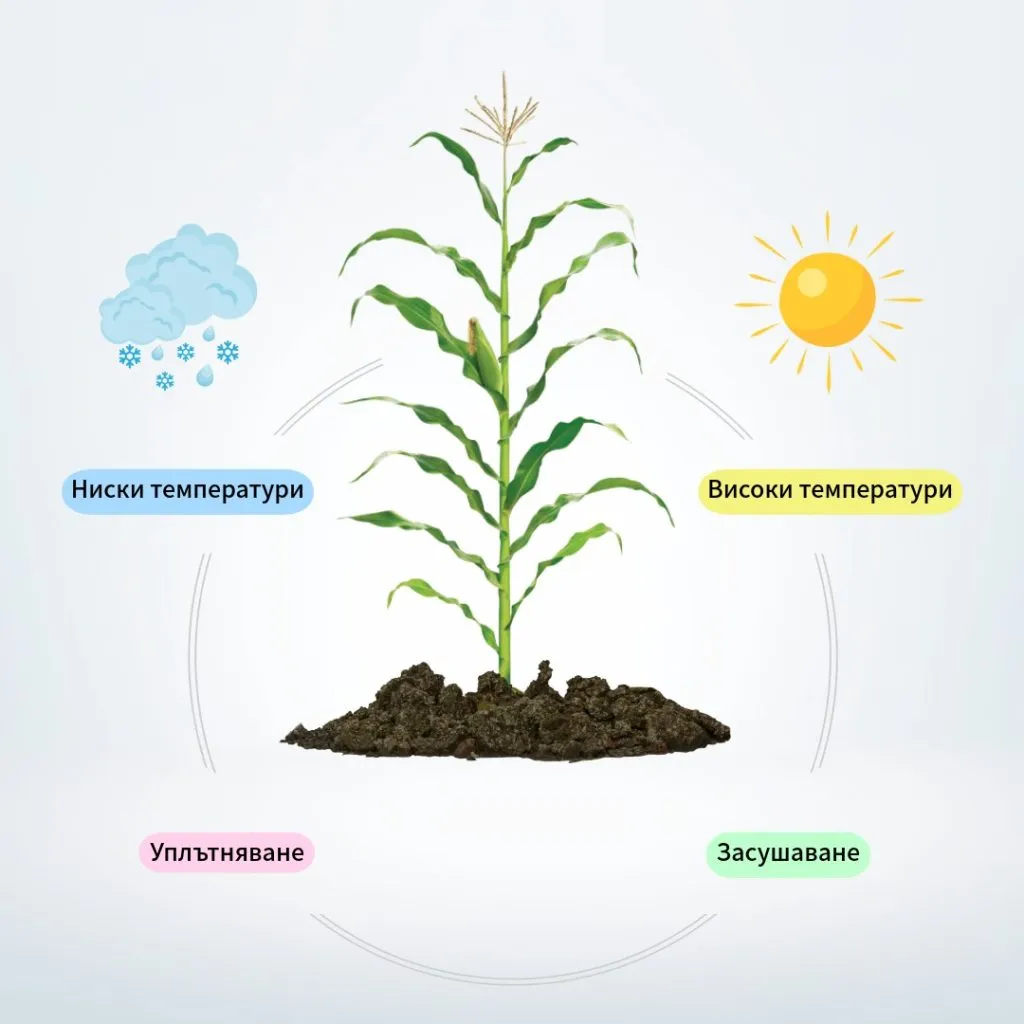
High temperatures combined with drought
Problem.
The prolonged impact of high temperatures and the lack of sufficient rainfall cause the so-called. heat stress. Leaf shrinkage is the first symptom by which plants signal a problem has occurred. In this way, they regulate the evaporation of water from their tissues and try to counteract extreme conditions. If the heat persists for a long time, burns occur, and then wilting, which in some cases is irreversible.
High degrees also have a direct bearing on the process of photosynthesis — as they rise, it slows down. In the event that such conditions coincide with the period of flowering, fertilization and grain formation, it is quite likely that there will be negative consequences on the crop. This is due to the fact that the needs of the culture for water during this period are greatest.
Solution.
In many cases, protecting plants from temperature stress is an overwhelming task. However, there are practices that can delay the action of adverse conditions, as well as those that will help the culture to adapt more easily to them. Irrigation is an indispensable solution when we talk about providing the crop with water. Row spacing mulching is another effective method of dealing with excessive weeding and evaporation of water from the soil. Modern genetics also offers many options for choosing hybrids that are distinguished by good drought resistance and exposure to intense sunlight.
What do we advise you?
Do not feed — both in drought conditions and in periods of extremely high temperatures. The application of plant protection products when plants are under stress is also desirable to avoid. When the temperature rises above 27°C, most of the preparations not only become ineffective, but can also further damage the crop.
Follow our page for more interesting topics, and in case you have any questions — do not hesitate to contact us.
For more useful content, subscribe to our newsletter!
Contact us
Other articles
Field Innovations: Chomstil is among the first farms in Bulgaria with a Kverneland Alentix spreader
.webp)