2 Ways to Optimize Your Costs and Increase Yields by Implementing New Fertilization Technologies and Practices
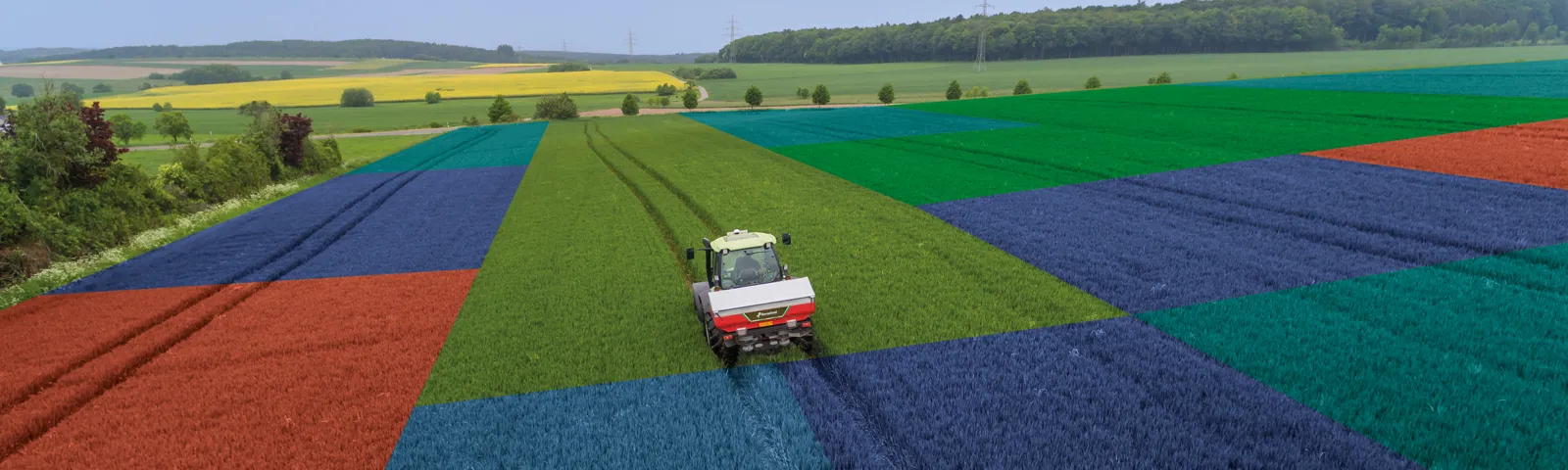
Every farmer has made an estimate of his expenses and knows that fertilizer costs are one of the biggest cost feathers on a farm. However, have you ever thought that, at the same time, threshers are one of the cheapest inventory that every farmer has on his farm?
Betting on intelligent milling machine with accurate weighing system, section control and computer control, experts say that every farmer can save noticeably already in the first year! However, saving without affecting the yield at the time of harvest and the good start of the crops is not an easy task. That is why we share two easy-to-follow steps that you can implement and be sure that your plants will not suffer from a lack of nitrogen, phosphorus or any other important element for them, which can affect the yield. At the same time, you ensure that the fertilizer will be evenly scattered, in the right placesin which it is needed.
The first step — precisely working inventory
You must be wondering why inventory is so important? Because technology is evolving with each passing year, and rolling mills are one of the inventories where innovations have been entering at an extremely fast pace in the last 15 years.
Why are Kverneland grinders the most precise on the market?
CenterFlow fertilizer spreading system
Kverneland grillsare known for unsurpassed quality and strength, which give the rigor for a job well done. Thanks to the patented CentreFlow system with 8 blades, they carry out extremely uniform spreading of fertilizer without crushing the granule and dusting the fertilizer.
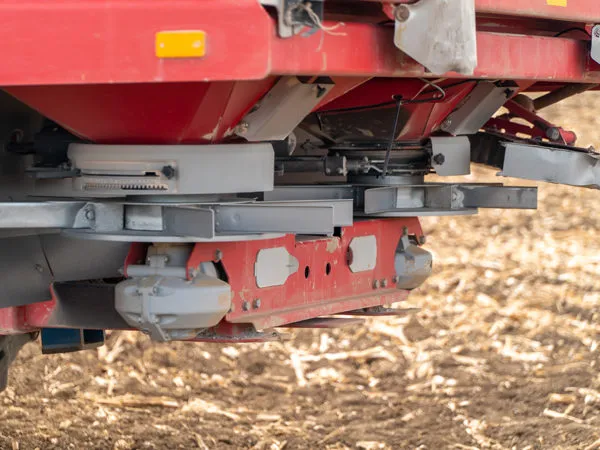
The double overlapis also a guarantor of precise spraying, and it is extremely easy to work with, because the machine itself calculates where how many kilograms to deliver when you are at the end of the field. So you know that always, with all traces, the fertilization rate is exactly the one that is set on the mower control monitor. The fertilizer makes contact with the blades always at one point and even with large slopes the field coverage and the application of the norm are uniform.
ISOBUS compatibility
The ISOBUS system of the Kverneland threshers is certified by the AEF (Foundation for Agricultural Electronics). In this way Kverneland mowers are compatible with all ISOBUS navigation systems and all tractors equipped with ISOBUS. It was in 1986 that Kverneland invented the ISOBUS communication technology between inventory and machine.
Sectional control when fertilizing

With the help of the GEOSPREAD system implemented in the Kverneland threshers, every farmer gets a perfect result. In combination with a GPS receiver that gives information about the position of the machine with an accuracy of 2.5 cm and the GEOSPREAD technology of Kverneland, with which the working width is automatically reduced, every farmer can reduce their costs by up to 15% by reducing unnecessary overlap. This is the so-called sectional fertilization control, in which the working width can be reduced in increments of 4 meters to 1 meter. This is how it is achieved very accurate spreading of fertilizer without changing the revolutions of the disks, without fertilizing outside the boundary of the plot, while at the same time optimizing the quantity of fertilizer consumed, since it is fertilized only within the limits and not outside them.
Weighing system that gives every farmer the accuracy he needs
The weight system in Kverneland lathes is equipped with 1 or 4 weight cells (depending on the model) and one reference sensor with a built-in gyroscope. Each cell gives instantaneous information about the weight, and the reference gyroscope sensor filters the data from each cell and gives information about the slope, with a measurement deviation of up to 0.1%. Through the unique sensor technology, the grinder performs constant automatic calibration, which prevents possible deviations from the norm and uneven fertilization in hilly terrain or during shock impacts in heavy terrain.
The calibration of the mower is carried out with the AutoSetáPP application, with which the input of the machine settings for the respective fertilizer occurs within a few minutes, after which the machine performs its calibration by itself.
The second step is variable rate fertilization
Geospread Kverneland GeospreadThey offer an opportunity to implementation of VRA— variable rate of fertilizer application, which allows the application of fertilizer in different quantities in different areas according to the needs of the field. Through the VRA functionality, the machine can perform a different norm on each disc, and through GEOSPREAD and the patented weighing system, results in unsurpassed results of effective fertilization.
Variable rate fertilization allows the farmer to give the exact amount of nutrient the crops need, such as takes into account the stock of the soil. This is a good way to reduce the total amount of fertilizerwhich is applied while at the same time increase the quality of fertilizing and its effectiveness.
Taking advantage of the results of soil and plant sampling offered by NIK Agro Service, or the vegetation index maps in the GeoScan satellite monitoring platform, farmers in Bulgaria can obtain a VRA card — the so-called variable rate fertilization map. This VRA map implemented using a Trimble navigation receiver and smart mower from the models TL GEOSPREADand CL GEOSPREAD, will give the ability to feed the weaker areas in the field and equalize the stock and availability of nutrientsto feed the crop in the coming season!
The main advantages of VRA fertilization, according to the specialists and farmers who apply it, are:
Correct fertilization
Farmers have the opportunity to fertilize optimally — with the right amount, in the right place at the right timeand thus reduce one of the main limiting factors for crop development, namely the sufficient amount of nutrients in the crop in each area of the field.
Optimization of costs
Optimization of fertilization costs can be done by carrying out a soil sampling at an appropriate time period to determine the stock of the soil after the previous crops have been harvested from a field. Sampling to create a VRA fertilization map takes more soil samples than standard soil sampling.

The number of soil samples formed from a plot of 669 acres, as is the example in the farm ofemedelic producer Stoyan Bonev, is four times the number determined by the BDS standard (ISO 10381). This allows obtaining more detailed information about the distribution of nutritional elements. In the case of the observed block, the number of soil samples to be taken as standard was 10, while for VRA purposes 39 were taken.
The sampling carried out by the most experienced team in the field — that of NIK Agro Service, and the subsequent analyzes show that there is uneven distribution of the stock of indigestible phosphorus, which is a prerequisite for some of the plants to experience phosphorus deficiency and others to oversaturation if TSP fertilization is carried out at the same rate throughout the plot.

To achieve better results in the vegetation of his crops, Stoyan Bonev from Agrocommerce 98 decided to apply a variable rate of fertilization with TSP, which would guarantee the same stock in all areas of the field, so that the crops have access to the same amount of digestible phosphorus. In order for the objectives of variable fertilization to be met, it is advisable to use one-component fertilizers containing the nutrient with which the variable fertilization will be carried out. In this case, a prescription has been drawn up for alternating fertilizing with phosphorus in the form of triple superphosphate (TSP, 0-46-0). The prescription is provided in the form of eelectronic files that are loaded into the navigation system.

Separately, an electronic map is drawn up, which shows the magnitude and distribution of fertilizer rates within the boundaries of the field.
The economic benefit of VRA fertilization
When applying variable fertilization technology, smaller or greater savings are often realized in the quantities of fertilizers applied. However, the greatest benefit comes from the introduction of the right amount of fertilizer in the right place. In this way, conditions are created for leveling the supply of nutrients, and this in turn has a beneficial effect on the yield obtained in the long term.
The table below presents a comparison for the fertilization of the block under consideration in the farm of “Agrocommerce 98" with a flat rate of fertilization and with a variable fertilization rate, and it is clearly seen that in addition to more uniform access to phosphorus for its plots, the agricultural producer Stoyan Bonev also realized savings on his fertilizer costs in this plot, thus the benefits for it become twofold.
The application of the VRA fertilization map, prepared on the basis of soil analysis in the specialized laboratory of NIK, in the specific farm is also carried out with lawn mower Kverneland TL GEOSPREADin combination with navigation receiver Trimble FMx, which are part of the technique available to the farmer.
Other articles
Field Innovations: Chomstil is among the first farms in Bulgaria with a Kverneland Alentix spreader
.webp)